
foundations
Can High-Power Really Be Safe to Touch?
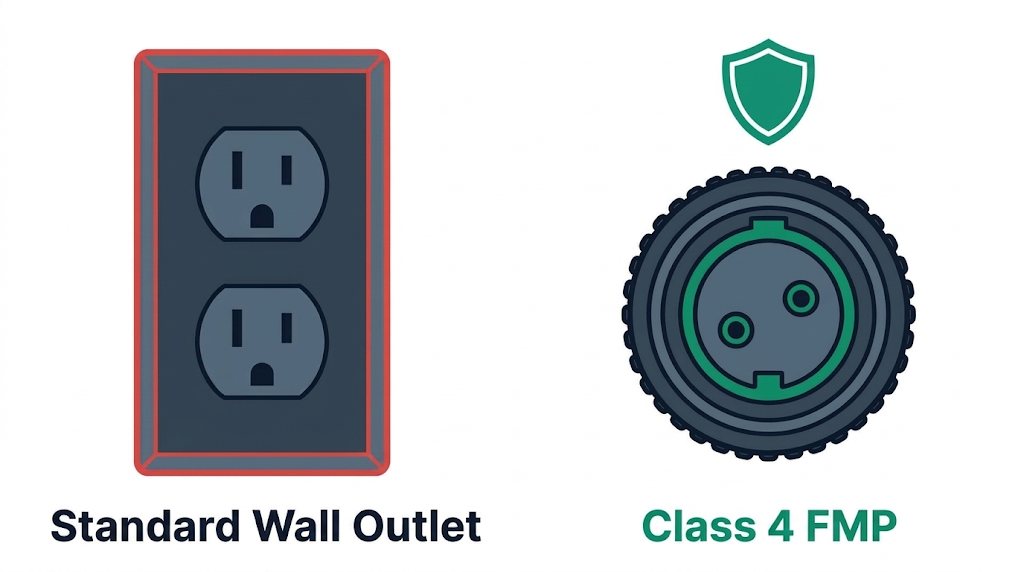
Traditional AC and DC circuits are protected by an absolute power limit. Once the limit is exceeded, the circuit shuts off. The idea behind FMPS is that the system watches the circuit all the time and cuts the power the moment something goes wrong. In theory, it can send unlimited power as long as it shuts off in zero seconds.
Why the Fault Response Matters
A Class 4 transmitter checks the circuit before it sends power. If it detects a fault, such as a short or a person touching the wires, it stops transmitting power. Instead of limiting the total power, FMP limits the energy into a fault.
Take a look at the comparison of FMPS to other safety options.
| Type of Fault | GFCI Protection | AFCI Protection | FMPS Protection |
|---|---|---|---|
| Shock - Line to Earth | YES | YES | YES |
| Shock - Line to Line | NO | NO | YES |
| Fire - Series Arc | NO | YES | YES |
| Fire - Parallel Arc | NO | YES | YES |
| Fire - Line to Line Resistive | NO | NO | YES |
| Fire - Series Resistive | NO | NO | YES |
Compare the differences between power distribution options.
| Parameter | AC Power | Class 2 LVDC | Class 4 FMPS |
|---|---|---|---|
| Voltage Limit | Up to 1,000 Vac | Up to 60 Vdc | Up to 450 Vac or Vdc |
| Power Limit | Up to MW | Up to 100 W | Unlimited |
| Distance Limit | ~300 ft* | ~1,000 ft** | 6,000 ft |
| Conduit Required | Yes | No | No |
| Permits Required | Yes | No | No |
*To keep voltage drop at or below 3% on a single-phase 240V circuit.
**Practical limit, delivered power decreases with distance.
The Takeaway
Class 4 power was built around fault management. Respect the system, follow the code, and use qualified installers.