
foundations
The Basics of Electricity
By ChatFMP Subject Matter Expert · Reviewed by Luke Getto · Last reviewed November 16, 2026
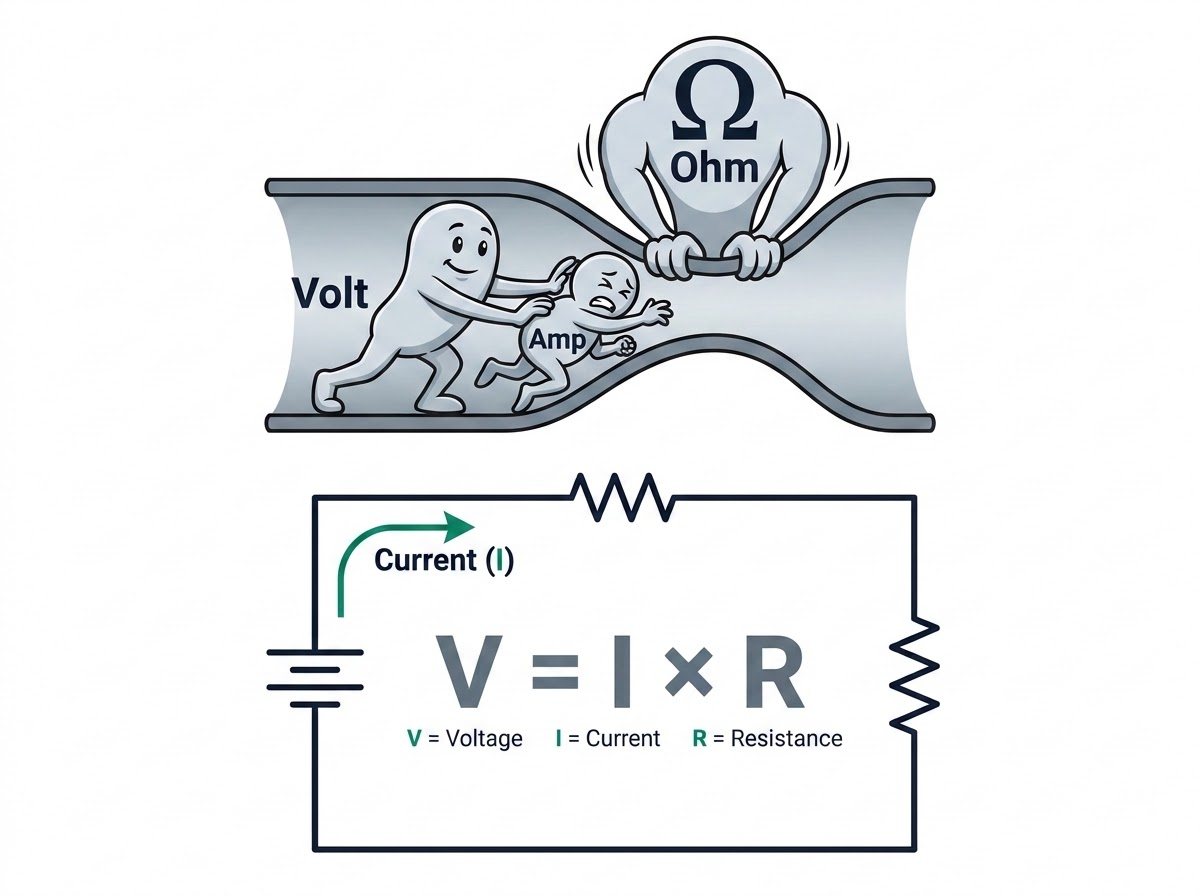
Not everyone is an electrical engineer, so let’s start with the basics.
Three Ideas to Know
- Voltage is the push. It is the difference in electrical potential between two points.
- Current is the flow. It is how many charges move past a point each second.
- Power is the work being done. It is roughly voltage times current, for DC circuits.
The values are determined using Ohm’s law.
Why This Matters for Class 4
Class 4 power uses higher voltage than both traditional 120/240Vac and Class 2 low-voltage circuits. It limits energy during a fault instead of relying only on limiting the source. Understanding voltage, current, and power makes the rest of the Class 4 story easier to follow.
What to Remember
- Voltage alone does not tell you how dangerous a circuit is.
- The path, time duration, and amplitude of the current does too.
- Good design controls all of these at once, but FMP does it natively.
PowerElectricity